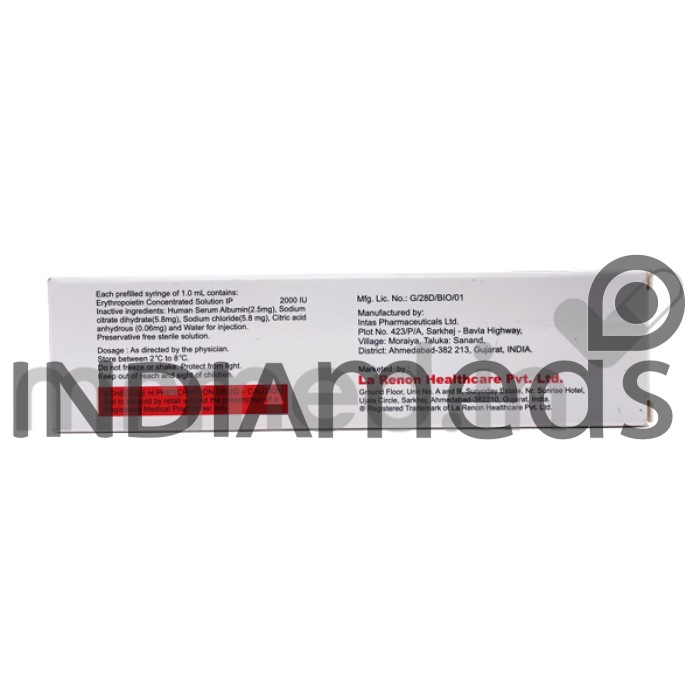
Contains active components such as Recombinant human erythropoietin alfa/epoetin alfa.
Belongs to a class of drugs called erythropoiesis-stimulating agents (ESAs).
Uses
Treats anemia caused by chronic kidney disease (CKD), cancer chemotherapy, or HIV infection treatment with zidovudine.
Reduces the need for red blood cell transfusions in patients at high risk for blood loss due to planned surgery or other procedures.
Contraindications
Do not use in patients with hypersensitivity to it or any of its components.
Do not use in patients with uncontrolled hypertension.
Do not use in patients with active thrombotic microangiopathy (TMA), pure red cell aplasia (PRCA), uncontrolled seizures, pregnancy, or lactation.
Use cautiously in patients with a history of blood clots, heart disease, stroke, kidney disease, liver disease, thalassemia, sickle cell anemia, myelodysplastic syndrome, leukemia, or cancer.
Should only be used in children under 18 if the benefits outweigh the risks.
Interaction with other drugs
Inform the doctor about all your medicines, including prescription, over-the-counter, nutritional or vitamin supplements, and herbal products.
Storage
Store at room temperature, between 2°C to 8°C.
Keep away from moisture, heat, and light.
Do not freeze.
Keep away from children and pets.
Administration
Given by subcutaneous injection, which means it is injected under the skin.
The injection is usually given in the abdomen, thigh, or upper arm.
Safety advices
Pregnancy: talk to your doctor about the risks and benefits.
Breastfeeding: consult a healthcare provider before using this medication while breastfeeding.
Lungs: consult your healthcare provider before taking Anfoe 2000 IU Injection if you have lung conditions.
Liver: talk to your doctor about the risks and benefits if you have liver disease.
Alcohol: it is unsafe to take Anfoe 2000 IU Injection with alcohol.
Driving: it is not safe to drive after receiving Anfoe 2000 IU Injection.
Common: headache, nausea, vomiting, diarrhea, muscle cramps, pain at the injection site, redness, swelling, or itching at the injection site, fatigue, dizziness, chills, fever.
FAQs
Q1. What happens if I miss a dose of Anfoe 2000 IU Injection?
A1. Contact your doctor as soon as possible. They will advise you on whether you need to take a double dose.
Q2. How long does it take for Anfoe 2000 IU Injection to work?
A2. It usually takes about 2-4 weeks for Anfoe 2000 IU Injection to start working.
Q3. Can I get Anfoe 2000 IU Injection over the counter?
A3. No, Anfoe 2000 IU Injection is a prescription medication and cannot be purchased over the counter.
Q4. What is the dosage of Anfoe 2000 IU Injection?
A4. The dosage will vary depending on your individual circumstances. Your doctor will determine the appropriate dosage for you.
Q5. What are the most common side effects of Anfoe 2000 IU Injection?
A5. The most common side effects are headache, nausea, vomiting, diarrhea, muscle cramps, pain at the injection site, and redness, swelling, or itching at the injection site.
Q6. What should I do if I have a leftover Anfoe 2000 IU Injection?
A6. Return it to your doctor or pharmacist. Do not throw it away in the trash.
Fact box
Molecule name: Recombinant human erythropoietin alfa/epoetin alfa.